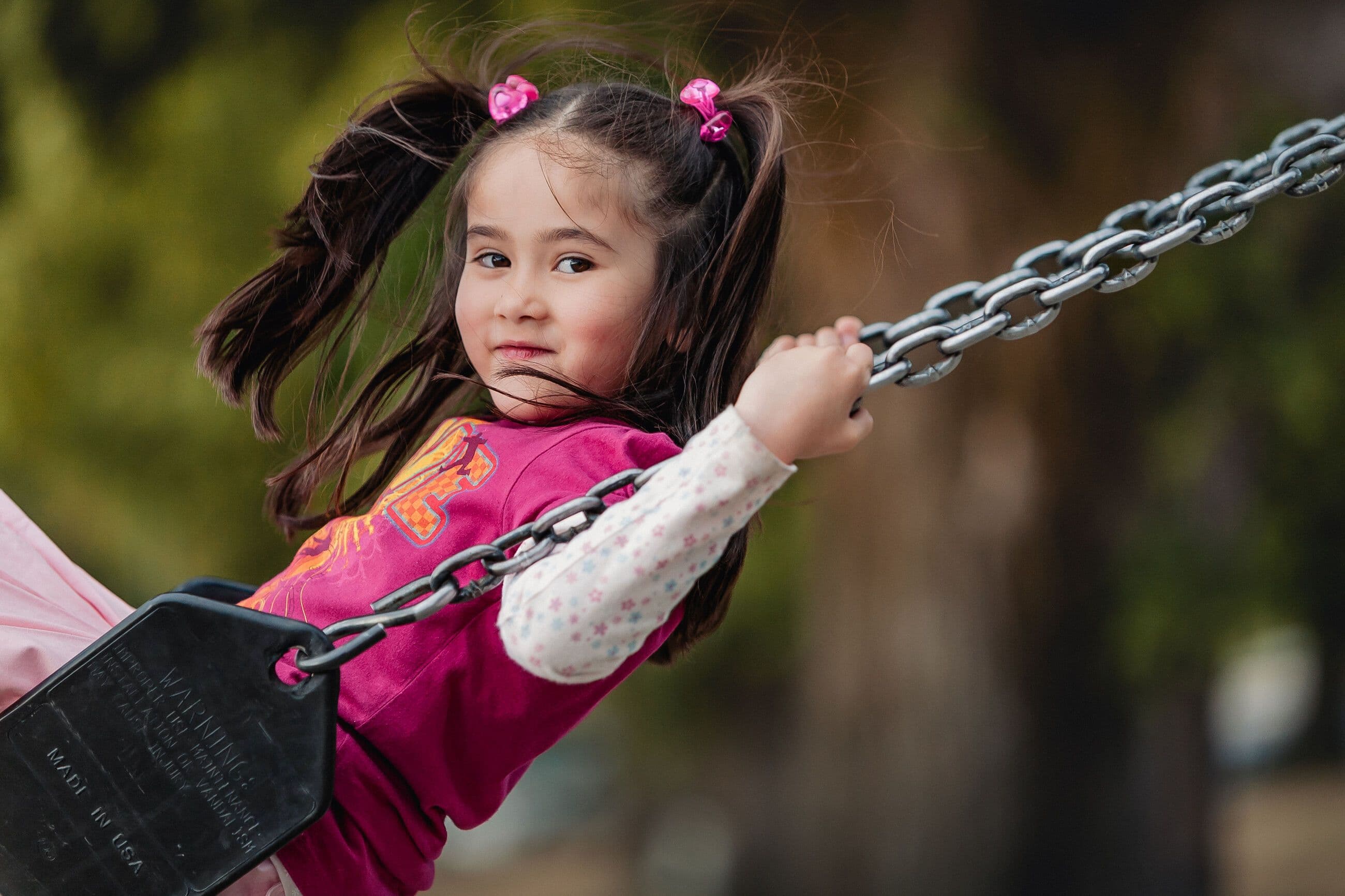
Your child follows the whole conversation. They laugh at the joke before you finish it. They know exactly what Grandma just asked. And then they answer in English.
If that's your evenings, you're not raising a child who "failed" at the language. You're raising a receptive bilingual, and there's a name for it because it's one of the most common patterns in multilingual families on earth.
What receptive bilingualism actually means
Receptive bilingualism is a large gap between understanding and speaking: a child (or adult) who comprehends a language well but produces little of it. Linguists also call it passive bilingualism, though many researchers now prefer "receptive," because "passive" makes it sound like nothing is happening. Something is very much happening. Comprehension is a skill, and your child has it.
Two things are worth knowing right away, because they change how you feel about the whole situation.
First, the "understands everything, says nothing" child is mostly a myth. Marianne Sherkina-Lieber, who wrote her doctoral thesis on exactly these speakers, found that so-called pure receptive bilinguals don't really exist: they all produce at least some words, and they typically understand around 80% of what they hear rather than every word. In other words, your child is closer to the middle of a spectrum than to a wall. There's a working system in there, just lopsided toward the listening side. Her broader classification of receptive bilinguals is a good primer if you like the academic version.
Second, receptive bilingualism is a real, valid form of bilingualism, not a consolation prize. Understanding a language is the foundation everything else is built on. A child who understands has already done the hard, invisible work. What's missing isn't knowledge. It's output.
Why it happens
First, know that you're in enormous company. In one of the largest studies ever done on bilingual families, Annick De Houwer surveyed 1,899 families in which a minority language was spoken at home. Every single child spoke the majority language. About one in four did not speak the home language, despite hearing it their whole lives. Receptive bilingualism isn't a rare malfunction. It's one of the most common outcomes of raising a child between two languages.
It usually creeps in around school age, and the reason is almost mathematical.
Before school, the home language paid for everything: food, comfort, cartoons, bedtime, the people who love them most. Then school arrives and the majority language suddenly buys the entire outside world: friends, jokes, playground status, teachers. The home language keeps its meaning but loses its monopoly, and a young brain does the efficient thing. It keeps understanding (cheap, automatic, happens whether they try or not) and quietly stops producing (effortful, and unnecessary when the other language works everywhere).
Exposure imbalance is the engine underneath. When a child hears far more of one language than the other, and only needs one of them to get through the day, the weaker language slides into receptive mode. Developmental psychologist Erika Hoff, whose lab has followed bilingual children in Florida for years, puts it plainly in her review Why bilingual development is not easy: bilingual environments vary enormously in how much of each language children actually hear, and the minority language is the one that pays the price when the balance tips. Researchers studying dual language learners note there's no single moment this happens; it's a gradual tilt driven by how much the child hears the language and how much they actually have to use it.
Birth order plays a quiet role too. Janice Nakamura's work on receptive bilingual children's language use found that younger siblings are more likely to become receptive bilinguals than their older siblings, partly because big brothers and sisters flood the house with the majority language and even nudge their parents toward using more of it. If your second child speaks less of the home language than your first did, you didn't do anything wrong. The living room changed.
None of this is defiance, and reading it as defiance is the single most common way families make it worse.
The output gap: why understanding doesn't automatically become speaking
Here's the part that surprises most parents. Understanding a language and speaking it are not the same skill, and getting good at one does not automatically hand you the other.
The applied linguist Merrill Swain noticed this decades ago while studying French immersion students in Canada. After years of rich input, the kids understood French like natives, but their speaking stayed stubbornly behind, full of gaps and errors. Input alone hadn't done the job. From that puzzle came her output hypothesis: the idea that producinglanguage does something for the brain that merely absorbing it can't. In a now-classic study, Swain and Lapkin (1995) showed that the act of producing a sentence forces learners to notice the gaps in their own knowledge, and that this noticing is itself part of how the language gets learned.
Why? Because comprehension lets you cheat. When you listen, you can catch the gist from a few keywords, tone, and context, without fully parsing the grammar. Production won't let you cheat. To say the sentence yourself, you have to actually assemble it: choose the words, order them, get the endings right. Swain's point was that this act of building forces a deeper kind of processing, the kind that turns passive knowledge into a usable skill.
This is the crux of receptive bilingualism. Your child's listening brain is fluent. Their speaking brain hasn't been asked to build much, because it never had to. Closing the gap isn't about more understanding. It's about creating low-stakes reasons to produce.
Five research-backed moves that reopen the door
None of these is "make them speak." That's the one move that reliably backfires, because the moment the language becomes a requirement, speaking it becomes a test, and no child volunteers for a test they might fail in front of the people they most want to impress.
1. Recast instead of correct. When your child answers in the majority language, or mangles a sentence in the home language, don't stop to fix it. Fold the correct version into a warm, natural reply and keep the conversation moving. Child: "Con muốn eat cơm!" You: "Con muốn ăn cơmà? Được, mình ăn thôi!" They hear the full correct sentence tucked inside a yes, and the conversation survives. Nakamura's research on parents' discourse strategies with receptive bilingual children found that recasting, modeling, and expanding on what a child says are far more effective at pulling them back into the language than directive moves like "say it in Vietnamese."
Child: "Con muốn eat cơm!"
Correction: "No. Say ăn. Say ăn cơm." (Speaking just became a test. Door closes.)
Recast: "Con muốn ăn cơm à? Được, mình ăn thôi!" (The child hears the full correct sentence inside a warm yes, and answers back.)
2. Use gentle prompts, not commands. A puzzled "hmm?" or "what?" or "sorry, tell me again?" invites the child to have another go, in the home language, without it ever feeling like an order. This "minimal grasp" style of prompting, rooted in Elizabeth Lanza's family interaction research and carried forward by Nakamura and Annick De Houwer, signals that you'd genuinely love to hear it again, and gives them room to produce on their own terms.
3. Keep the input coming, no matter what they answer in. The strong temptation, when a child keeps replying in English, is to give up and switch. Don't. Stay in the home language even when they don't. Every sentence you speak is feeding the system that will eventually produce. The research review Bilingualism in the Early Years: What the Science Saysis blunt about the arithmetic: quantity of exposure is one of the strongest predictors of a language's fate, and experts often recommend tilting input towardthe minority language, since the majority language will take care of itself. And Nakamura's work makes the long-game case explicitly: the possibility of active bilingualism later in life is reason enough to keep supplying the weaker language now, even during stretches when nothing seems to come back.
4. Give the language a real job. Kids don't practice languages; they use them, when there's something worth using them for. A grandparent on video call whose best stories only work in your language. A song. A recipe you cook together. A bedtime story that only exists in the home language. When speaking is the way to get something the child actually wants, output stops feeling like homework and starts feeling like a key.
5. Build speaking on top of listening, not instead of it. This is the whole logic of the output gap: you don't yank a child straight from silence to conversation. You give them something to listen to, then something to read along with, then something to talk about, in that order, each step lowering the stakes of the next. A child who has just heard and read a story has the words loaded and ready; talking about it is a much smaller leap than being put on the spot cold. Stories are an unusually good vehicle for this: a cluster-randomized trial of 464 bilingual preschoolers published in Child Developmentfound that content-rich shared reading, with talk built around the book, produced significant gains in children's weaker-language vocabulary and grammar. The book does the heavy lifting; the conversation rides on top of it.
And then the hardest move of all: expect nothing for a while. Progress in receptive bilingualism is invisible for months. Then one evening they say a whole unprompted sentence to their grandmother on the phone, and you have to leave the room for a second. That's how it arrives.
Where ReadClub fits
We built ReadClub around that fifth move, because it's the one families have the hardest time engineering at home.
Every story runs in three stages, in the order a receptive bilingual actually needs them. Listen:the story with native-accent narration, every word lighting up as it's spoken, nothing asked of the child yet. Read aloud: they read the page at their own pace, and a wobbly word gets a gentle model instead of a red mark. Talk:afterward, the Voice Tutor chats about the story, and it's built on recasting. If your child says "the elves maked the shoes," it replies, "Yes, the elves madethe shoes while everyone slept. What do you think the shoemaker felt?" The correct form arrives inside the conversation, the way it does from a good grandmother, and the child keeps talking.
Input, then supported reading, then real production. Understanding into speaking, one story at a time.
Receptive bilingualism isn't the end of your child's home language. It's the middle of it. The understanding is already there. The speaking is a door, and it opens from the inside, when there's a reason worth opening it for.
Start with one story tonight. Pick your language, press play, and just listen together. No credit card required.
Explore storiesSources
- Sherkina-Lieber (2020), A classification of receptive bilinguals, Linguistic Approaches to Bilingualism
- De Houwer (2007), Parental language input patterns and children's bilingual use, Applied Psycholinguistics
- Hoff on bilingual development
- Nakamura (2018–2019) on receptive bilingual children's language use and parents' discourse strategies
- De Houwer & Nakamura (2021) on discourse strategies with bilingual children
- Swain & Lapkin (1995) on output and cognitive processing, Applied Linguistics
- Byers-Heinlein & Lew-Williams (2013), Bilingualism in the Early Years
- Grøver et al. (2020) on shared book reading with dual-language learners, Child Development
- Dual Language Learners Program on receptive bilingualism