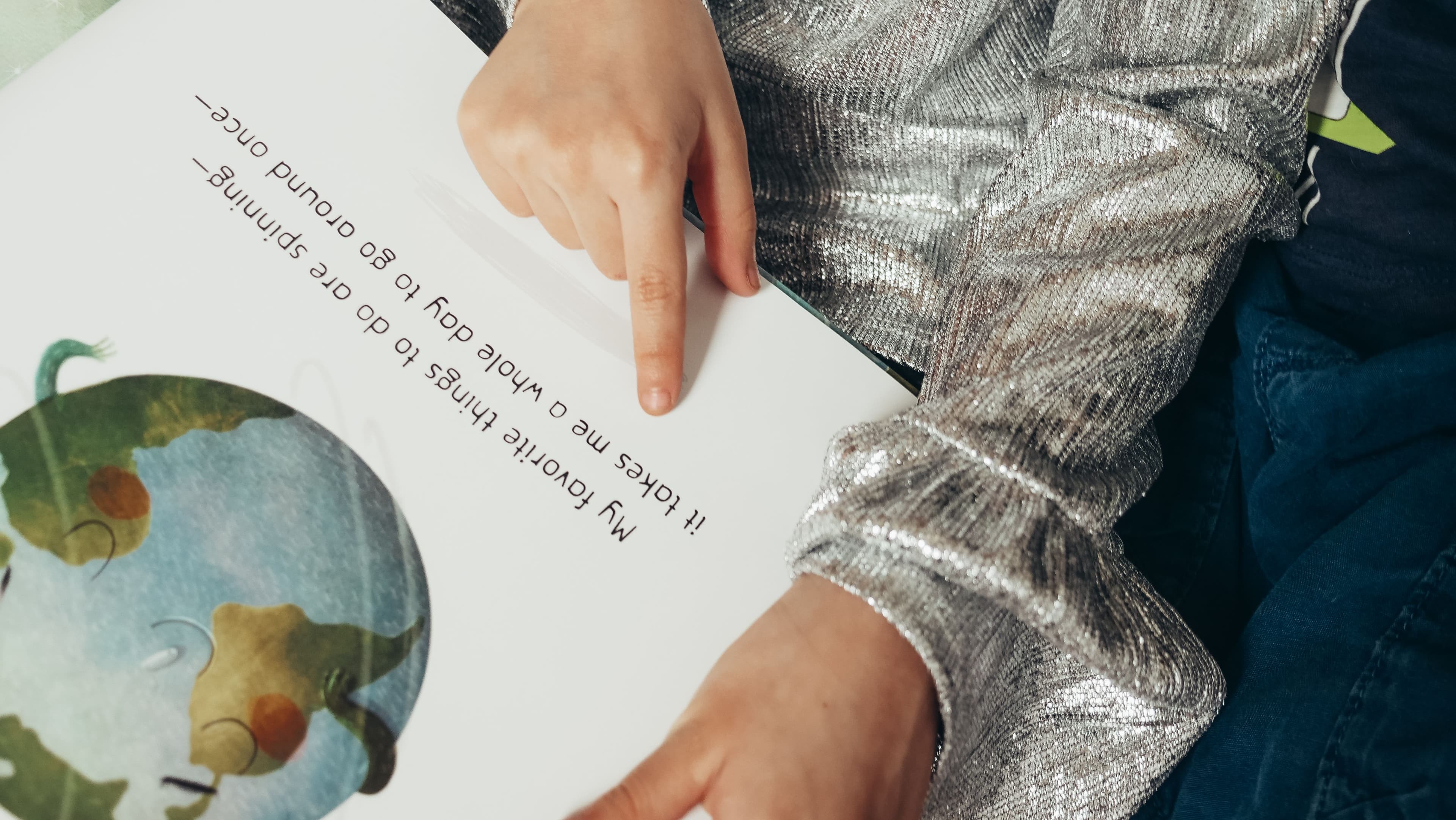
Watch a parent read to a small child and you'll almost always catch the same tiny move: a finger, sliding under the words.
It looks like nothing. It's actually one of the most useful things you can do. That finger is telling the child a secret: these marks on the page are the sounds coming out of my mouth. Spoken language, caught and pinned down so you can see it.
Word highlighting reading is that finger, made digital. As the narrator reads, each word lights up at the exact moment it's spoken. The child never has to hunt for where the voice is. They can just see it, and follow.
That's the whole idea. And for one kind of child in particular, the one who understands their family's language perfectly but goes quiet when it's their turn to speak, it turns out to matter a great deal.
Does read along help kids read?
Short answer: yes, when it's done well.
Not because a highlighted word is magic, but because reading is a juggling act. A beginning reader is matching letters to sounds, tracking left to right, holding the meaning in their head, watching for punctuation, and trying not to lose their place, all at once, all in real time. Highlighting quietly takes one ball out of the air. It handles "where am I?" so the child can spend that energy on the story instead. Researchers keep finding the same thing. In a 2025 eye-tracking study, Danish second graders read faster, backtracked less, and reread less when the word they were looking at changed color, with no cost to how accurately they pronounced words or how well they understood the story. Following along doesn't dumb reading down. It clears the runway.
Reading fluency isn't reading fast
Here's where a lot of parents get a wrong idea. We hear fluency and picture speed. A kid rattling through a page like an auctioneer.
Speed is a piece of it. But fluent reading really means reading accurately, at a comfortable pace, and with expression. That last part has a name: prosody. The rise and fall of the voice. The pause before the scary bit. The way a good reader makes a sentence mean something.
Take this line:
"Wait," shouted Maya, "don't open the door!"
A child can decode every single word and still read it flat:
"Wait shouted Maya don't open the door"
Same words. All the meaning gone. Timothy Rasinski's work has spent years making this exact point: that expression isn't decoration on top of "real" reading, it's part of understanding. When a child reads with feeling, it's proof the story actually landed.
Kids can't invent expression out of thin air, though. They have to hear it first: where the voice climbs, where it drops, where worry or delight sneaks in. That's what a good read-along gives them: a model to copy.
Why following along does so much at once
Slide a highlight under a sentence and three things happen together.
The child links sound to print, hearing "wolf" and seeing wolfin the same instant, over and over, until the two fuse. They stay on the page, because the moment their attention drifts, the highlight gently pulls them back to the exact word. And they absorb pacing, noticing that fluent readers don't stop-after-every-single-word, they group words into phrases that carry meaning.
Educators call the broader idea print referencing: pulling a child's eye to the print during a read-aloud instead of letting it wash over them. Highlighting isn't a teacher pointing out letters, but it does the same core job. It makes the print visible, in time, and tied to a voice. None of this replaces phonics or a good teacher or you on the couch at bedtime. Think of it as a bridge between two things that usually live apart for a struggling reader: hearing the words, and reading them.
The "understands everything, won't say a word" problem
Now the part this is really about.
If you're raising a bilingual child, you know this scene. Grandma asks a question over video. Your kid clearly gets it. They laugh, they nod, they lean in. And then, when it's their turn, they freeze, or answer in English, or look at you to do the talking.
It's easy to read that as the language slipping away. Usually it isn't. Understanding is cheap; your child racks it up just by listening. Speakingis the expensive part, the part that needs low-stakes reps, and most kids simply don't get enough of them in the heritage language to feel safe trying.
Read-along stories are unusually good at manufacturing those reps. A bilingual child can hear the story in the family's language, follow the highlighted words so sound and print click together, read it aloud with nobody grading them, and then talk about what happened. Input, then bridge, then practice, then their own voice, in one sitting, on repeat, until the words stop being Grandma's and start being theirs. The research backs the instinct. A large trial of dual-language preschoolers found that rich shared reading meaningfully grew their second-language vocabulary and grammar. And a 2025 study found that when Latine parents shared a bilingual book, they naturally used more of their heritage language, and a wider range of it, without using any less English. The book gives the whole family permission to talk.
Repetition isn't boredom. It's how this works.
When your child begs for the same story for the ninth night running, that's not a rut. That's the mechanism.
The first read, they're wrestling the words. The second, they catch the meaning. By the third, they start to soundlike a storyteller. The National Reading Panel's review of the research landed firmly here: guided, repeated oral reading, especially with a grown-up nearby, reliably lifts word recognition, fluency, and comprehension. For a bilingual kid, rereading is worth even more. A word they only half-owned gets heard, seen lit up, read aloud, and finally used in conversation: four shots at becoming a word they'd actually say to Grandma. So say yes to the ninth read. It's doing more than you think.
This is exactly how ReadClub is built
We didn't bolt word highlighting onto a reading app. We built the whole thing around the loop above: listen, read aloud, talk.
Your child hears the story with native-accent narration in the accent and region you choose, so the language on the screen matches the language at the dinner table. Every word lights up as it's spoken, so following along is effortless.
Then they read it back with Read Aloud, which listens and gently models any word that comes out wobbly: no red marks, no "try again," just the right version, warmly. And afterward the Voice Tutoractually chats with them about the story, folding correct forms into real replies the way a patient grandparent would. That's the missing rep most kids never get: a low-pressure conversation in the heritage language, about something they genuinely care about.
By the time they're telling Grandma what happened in the story on Sunday, it isn't the first time they've said those words out loud. It's the third.
How to use it at home tonight
You don't need to turn this into a lesson. This rhythm is plenty:
Listen first. Let the whole page or story play, no pressure. The first pass is just for enjoying it.
Follow the lights. Nudge your child to watch the words as they hear them. That's where sound and print fuse.
Read it back together. They can echo one line, claim a favorite sentence, or take the whole page. Keep it light; you're after confidence, not perfection.
Reread favorites. Every "again!" is more practice with expression. Grant it.
Then talk. End with a question that needs a real answer: Why do you think she did that? What would you have said? Can you tell Grandma what happened? That last one is where recognized words become spoken ones.
The best read-along stories still feel like stories
All the science in the world won't make a kid come back. A highlighted worksheet is still a worksheet.
Children come back because they want to know what happens next, and that's the moment the language actually sinks in, when they're too caught up in the story to notice they're learning. That's the bet ReadClub makes: real stories first, language through use, in the accents that make a child feel at home.
FAQ
Does read along help kids read? Yes. When children follow fluent audio while watching the text, they get a model of expressive reading and a clear path through the sentence. Paired with reading aloud and rereading favorites, it supports word recognition, fluency, and comprehension.
What is word highlighting reading? It's when each word is highlighted the instant it's spoken, so a child can connect the sound they hear to the printed word and follow the rhythm of fluent reading without losing their place.
Is word highlighting good for bilingual children? Especially so. It links the sound of a heritage-language word, its written form, and its meaning all at once, and the payoff is biggest when the child also reads the story aloud and then talks about it.
Does it replace phonics? No. It's a support, not a substitute for real instruction in phonics, vocabulary, and comprehension. It helps kids follow along and hear fluent reading while those skills develop.
Why does my child want the same story over and over? Because rereading is how fluency grows. Early reads are about decoding; later reads are where expression and deeper understanding show up.
Word highlighting is the finger under the line: each lit-up word shows a child where the voice is on the page, and that link is what turns listening into reading.
Start with one story tonight. Pick your language, press play, and just listen together. No credit card required.
Explore storiesSources
- National Reading Panel (2000), Findings on guided repeated oral reading
- Rummens & Beier on gaze-based word highlighting in second graders (2025)
- Chang & Millett on audio-assisted reading
- Rasinski, Rikli & Johnston on fluency and prosody
- Zucker, Ward & Justice on print referencing
- Grøver et al. (2020) on shared book reading with dual-language learners, Child Development
- Reinoso, Guendica & Weisleder, Leamos Juntos! on bilingual book-sharing, Journal of Child Language (2025)